


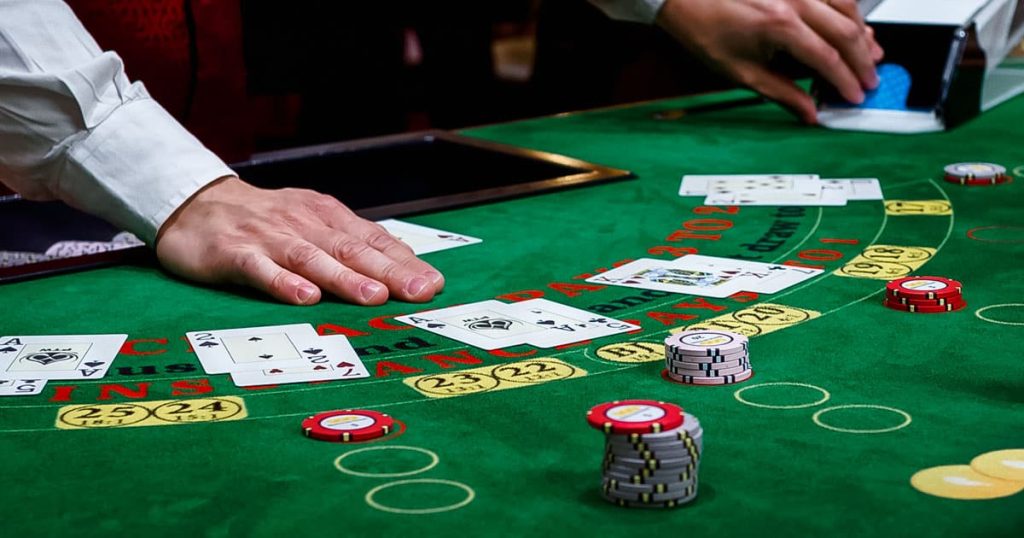
Blackjack stands apart from most casino games because math, not superstition, determines long-term success. While no strategy guarantees constant wins, understanding the mathematics behind blackjack dramatically reduces the house edge and improves decision-making.
This article breaks down the numbers, probabilities, and logic that give blackjack its reputation as the most player-friendly casino game.
Why Mathematics Matters in Blackjack
Every blackjack hand follows fixed probabilities based on:
- The number of decks in play
- Remaining cards in the shoe
- Dealer rules and table payouts
Unlike games based purely on chance, blackjack outcomes are influenced by statistical expectation, making math the foundation of winning strategies.
Understanding the House Edge
The house edge represents the casino’s built-in advantage over players.
In blackjack:
- Poor play can raise the house edge above 5%
- Optimal basic strategy can reduce it to around 0.5% or lower
This small edge is why blackjack attracts analytical players—it’s one of the few games where decisions truly matter.
Expected Value (EV) Explained Simply
Expected value measures how much you can expect to win or lose per bet over time.
- Positive EV: Favorable to the player
- Negative EV: Favorable to the house
Every blackjack decision—hit, stand, double, or split—has a mathematically calculated EV based on millions of simulated hands.
Winning players consistently choose actions with the highest expected value, even if individual hands still lose.
Probability and Card Distribution
Blackjack math is driven by card probabilities.
Key Probability Insights
- There are more 10-value cards than any other value
- Busting becomes more likely as hand totals increase
- Dealer outcomes are predictable due to fixed rules
These probabilities explain why standing on certain totals and hitting on others is mathematically optimal.
Why Basic Strategy Works
Basic strategy is a mathematically derived set of rules that tells players the best move for every possible hand combination.
It accounts for:
- Player total
- Dealer’s visible card
- Statistical outcomes of all possible next cards
Following basic strategy doesn’t eliminate losses, but it ensures:
- Minimal long-term losses
- Maximum efficiency against the house edge
The Role of Deck Count in Blackjack Math
The number of decks significantly affects probabilities.
- Fewer decks favor the player
- More decks increase the house edge slightly
Mathematical Impact of More Decks
- Lower probability of natural blackjack
- Slightly higher dealer advantage
- Reduced effectiveness of advanced strategies
This is why single-deck and double-deck games are mathematically preferable.
Blackjack Payouts and Their Mathematical Impact
Payout rules dramatically affect long-term results.
- 3:2 payout for blackjack: Player-friendly
- 6:5 payout for blackjack: Increases house edge significantly
From a mathematical perspective, avoiding 6:5 tables is one of the simplest ways to protect expected value.
Card Counting: Math in Motion
Card counting applies probability tracking to real gameplay.
It works because:
- Removing low cards increases the value of remaining high cards
- High cards favor the player with blackjacks and doubles
- Low cards favor the dealer by reducing bust risk
Counting doesn’t predict outcomes—it identifies statistical advantages when the deck composition shifts.
Variance vs Long-Term Mathematics
Short-term results can be misleading due to variance.
- Winning streaks don’t mean advantage
- Losing streaks don’t mean strategy failure
Blackjack math only reveals itself over thousands of hands, where probabilities stabilize and expected value becomes visible.
Bankroll Management and Mathematical Survival
Even with perfect strategy, variance can cause losses.
Mathematically sound bankroll management:
- Uses small betting units
- Avoids chasing losses
- Protects against variance swings
Survival is part of winning—math favors players who stay in the game long enough.
Common Myths That Ignore Blackjack Math
Many popular beliefs contradict mathematics.
Examples include:
- “The dealer is due to bust”
- “Hot tables increase winning chances”
- “Gut feeling beats strategy”
Blackjack outcomes reset every hand. Math—not memory—controls probability.
Frequently Asked Questions (FAQ)
Can math really help you win at blackjack?
Yes. While it can’t eliminate losses, it significantly reduces the house edge.
Is blackjack the most mathematical casino game?
It’s one of the most math-driven games, especially among table games.
Does perfect strategy guarantee profit?
No. It guarantees optimal decisions, not guaranteed wins.
How many hands are needed for math to matter?
Typically thousands of hands are required for probabilities to normalize.
Why do casinos still profit if blackjack is beatable?
Most players don’t use optimal strategy or manage bankrolls correctly.
Is card counting required to win long-term?
No. It improves advantage but isn’t necessary to minimize losses.
Does table speed affect mathematical outcomes?
It affects variance and bankroll swings but not expected value.
Blackjack rewards logic, patience, and probability awareness. Players who respect the mathematics behind the game don’t chase luck—they rely on numbers, discipline, and long-term thinking to stay ahead of the curve.